
Best Sleep Positions for Lower Back Pain Relief (And How to Actually Stay in Them) – Ann Arbor Chiropractor Tips
- posted: Feb. 18, 2025
By Dr. Tim Dehr, DC, CCSP | Performance Health Chiropractic
If your back hurts when you wake up, or if you're tossing and turning all night trying to find a comfortable position, your sleep posture is probably making things worse.
I see this all the time in my practice. A patient comes in with lower back pain, and when I ask about their sleep, they tell me they sleep on their stomach. Or they sleep on their side but wake up twisted like a pretzel. Or they've tried sleeping on their back but can't fall asleep that way, so they give up after ten minutes and go back to whatever position feels natural—even though that position is wrecking their spine.
Here's the reality: how you sleep matters. You spend roughly a third of your life in bed. If you're spending that time in a position that puts stress on your spine, you're essentially undoing a lot of the work we do during the day to keep your body aligned and functional.
But telling someone "just sleep on your back" is about as useful as telling someone "just eat healthier." Yeah, that's great advice in theory, but what does it actually mean? How do you do it? What if you've tried and it doesn't work?
So let me break down the best and worst sleep positions for your spine, why they matter, and—most importantly—how to actually make the transition if you're currently sleeping in a way that's causing problems.
Please note: This article is for informational purposes only and is not medical advice. If you're experiencing severe or persistent back pain, consult with a healthcare provider.
Why Sleep Position Matters for Your Spine
When you're awake, your muscles are actively supporting your spine. Even when you're sitting still, your core muscles, your back muscles, and your postural stabilizers are working to keep you upright and aligned.
When you sleep, those muscles relax. Your spine is supported entirely by the position you're in and the surface you're lying on.
Research supports the importance of sleep posture for spinal health. A study published in the Journal of Physical Therapy Science found that sleep position significantly affects spinal alignment and can contribute to or alleviate back pain. The study demonstrated that maintaining neutral spinal alignment during sleep reduces stress on intervertebral discs and surrounding soft tissues.
If you're in a position that maintains the natural curves of your spine—the slight inward curve of your lower back (lumbar lordosis) and the slight outward curve of your upper back (thoracic kyphosis)—your spine stays in a relatively neutral, low-stress position all night.
If you're in a position that flattens those curves, exaggerates them, or twists your spine, you're creating sustained stress on your joints, discs, ligaments, and muscles for 6-8 hours straight. Over time, that adds up.
This is why people wake up stiff, sore, or in pain even when they didn't do anything physically demanding the day before. Their sleep position is creating dysfunction.
The Best Sleep Position: On Your Back
Sleeping on your back is, biomechanically, the best position for most people.
Here's why:
It keeps your spine neutral. When you're lying flat on your back, your spine maintains its natural curves without being forced into flexion, extension, or rotation. Your head, neck, and spine are all aligned in a straight line.
It distributes your weight evenly. Your body weight is spread across a large surface area—your entire back, your hips, your shoulders. No single area is bearing excessive load, which reduces pressure points and strain.
It minimizes twisting. Unlike side sleeping or stomach sleeping, back sleeping keeps your hips, spine, and shoulders in alignment. There's no rotational stress on your spine.
How to do it right:
Use a pillow under your knees. This is the key to making back sleeping comfortable. Placing a pillow (or a rolled towel) under your knees slightly flexes your hips and takes tension off your lower back. Without this, your lower back can feel strained, especially if you have tight hip flexors.
Choose the right head pillow. Your pillow should support the natural curve of your neck without pushing your head too far forward or letting it drop back too far. A pillow that's too thick will push your head forward (forward head posture). A pillow that's too flat will let your head drop back and hyperextend your neck. You want your head to be in a neutral position—as if you were standing with good posture.
Let your arms rest naturally. Don't sleep with your arms above your head for extended periods. This can create tension in your shoulders and neck. Keep your arms at your sides or resting on your chest/stomach.
"But I Can't Fall Asleep on My Back"
This is the most common objection I hear. People try back sleeping for ten minutes, can't fall asleep, get frustrated, and roll over to their usual position.
Here's the thing: you're not going to fall asleep instantly in a new position. Your body is used to falling asleep a certain way. Changing that pattern takes time.
If you want to transition to back sleeping, here's what actually works:
Start by lying on your back while you read, watch TV, or wind down before sleep. Get your body used to the position in a low-stakes situation. You're not trying to fall asleep yet—you're just getting comfortable being on your back.
Use the pillow under your knees from the start. Don't try back sleeping without it. The knee pillow makes a huge difference in comfort, and most people who say they "can't sleep on their back" have never tried it with proper support.
Give it at least two weeks. It takes time to adjust. You might not fall asleep on your back the first few nights, but if you stick with it, your body will adapt. Many of my patients who "couldn't sleep on their back" eventually prefer it once they get used to it.
Accept that you'll probably roll over during the night. That's fine. The goal isn't to stay perfectly on your back all night—it's to spend more time in a better position than you currently do. If you fall asleep on your back and wake up on your side, you still got several hours in a good position. That's progress.
The Second-Best Position: On Your Side (Done Correctly)
If back sleeping doesn't work for you, side sleeping is the next best option—if you do it correctly.
Here's what makes side sleeping work:
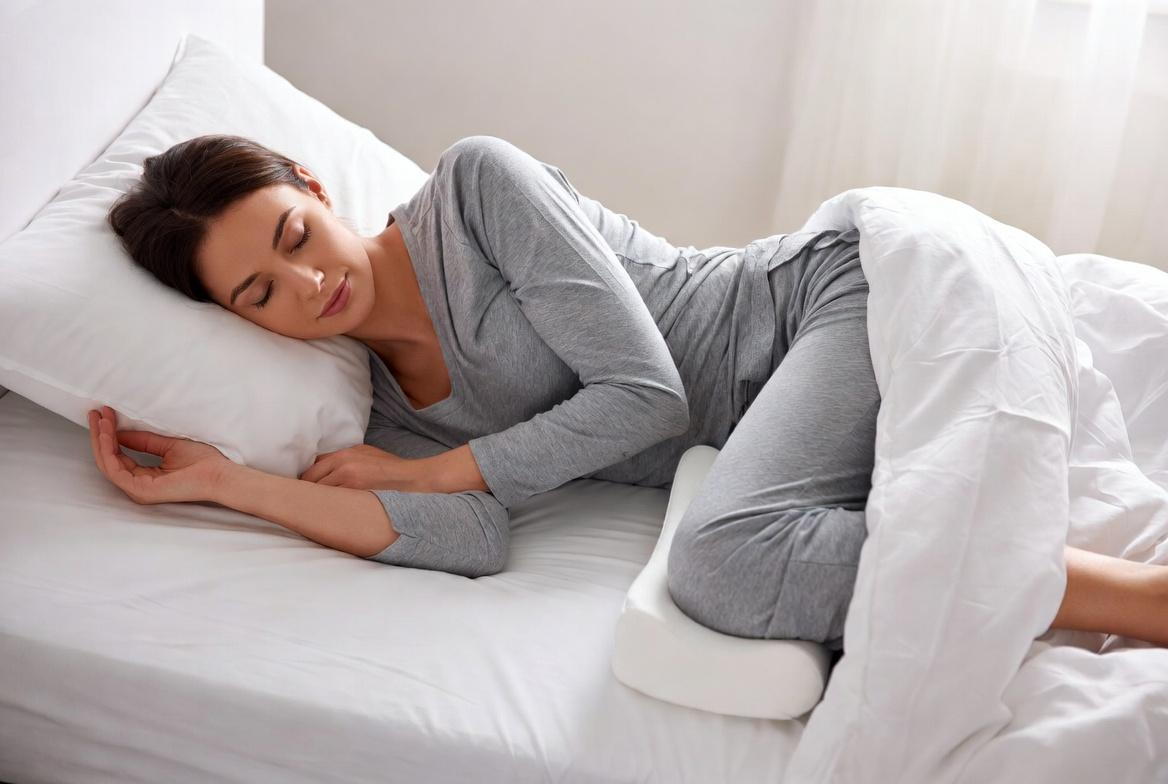
Use a pillow between your knees. This is non-negotiable. Without a pillow between your knees, your top leg drops down and pulls your pelvis into rotation. This creates a twisting force on your lower back and can lead to lower back pain, hip pain, or SI joint dysfunction.
A study in the Clinical Journal of Pain demonstrated that using a pillow between the knees during side sleeping significantly reduces pressure on the lumbar spine and pelvis, leading to decreased lower back pain in chronic pain patients.
The pillow keeps your hips level and your spine neutral. It's the single most important thing you can do to make side sleeping healthier for your spine.
Choose the right head pillow. When you're on your side, there's a gap between your shoulder and your head. Your pillow needs to fill that gap so your neck stays aligned with the rest of your spine. A pillow that's too flat will let your head drop toward the mattress, creating a side bend in your neck. A pillow that's too thick will push your head up and create the opposite problem.
Don't curl up too tightly. A slightly curled position (semi-fetal) is fine, but if you're pulling your knees up to your chest in a tight fetal position, you're putting your spine into flexion all night. This can create strain, especially in your lower back.
Avoid the "arm under the pillow" position. A lot of side sleepers put their bottom arm under their pillow or under their head. This can create shoulder problems over time—pinching the rotator cuff, compressing nerves, and creating chronic shoulder pain. Try to keep your bottom arm out in front of you or resting at your side.
Which Side Should You Sleep On?
For most people, it doesn't matter much. But if you have specific conditions, one side might be better than the other:
If you have sciatica or leg pain on one side, many people find relief sleeping on the unaffected side. This takes pressure off the affected nerve.
If you're pregnant, sleeping on your left side is generally recommended because it improves circulation to the baby and reduces pressure on your liver. Use a pregnancy pillow or a regular pillow to support your belly.
If you have shoulder pain on one side, sleep on the opposite side to avoid putting pressure on the painful shoulder.
If you don't have any of these issues, sleep on whichever side feels more comfortable. Some people naturally prefer one side over the other, and that's fine.
The Worst Position: On Your Stomach
Stomach sleeping is, biomechanically, the worst position for your spine.
Here's why:
It forces your neck into rotation. Unless you have a hole in your mattress to breathe through (you don't), you have to turn your head to one side to breathe when you're on your stomach. This means your neck is rotated 90 degrees for the entire night. That creates sustained strain on the joints, muscles, and ligaments in your neck. Over time, this can lead to chronic neck pain, stiffness, and headaches.
It flattens or reverses your lumbar curve. When you lie on your stomach, your lower back is either flattened out or, if your mattress is soft, your belly sinks down and your lower back goes into extension. Neither of these is a neutral position. Both create stress on the lumbar spine.
It can aggravate breathing and digestion. Lying face-down puts pressure on your chest and abdomen, which can make breathing feel restricted and can interfere with digestion. This is especially true if you have a softer mattress that lets you sink in.
"But I've Always Slept on My Stomach"
I know. And changing it is hard.
Stomach sleeping is one of the most difficult habits to break because people who sleep on their stomach often can't fall asleep any other way. They've been doing it for years, and their body associates that position with sleep.
But if you're dealing with chronic neck pain, upper back pain, or morning stiffness, stomach sleeping is very likely contributing to the problem.
If you absolutely must sleep on your stomach, here's how to minimize the damage:
Use a very flat pillow—or no pillow at all—under your head. This reduces the amount of extension in your neck. You're still rotated, but at least you're not also hyperextended.
Place a pillow under your hips/pelvis. This slightly elevates your lower back and reduces the extension (or flattening) in your lumbar spine. It doesn't fix the problem entirely, but it helps.
Try transitioning to side sleeping first. Going from stomach sleeping to back sleeping is a big jump. Try side sleeping as an intermediate step. It's easier to fall asleep on your side than on your back, and once you're comfortable side sleeping, you can work toward back sleeping if you want.
How to Stop Sleeping on Your Stomach
If you're serious about breaking the stomach-sleeping habit, here's what works:
Start the night on your side or back. Even if you roll onto your stomach later, you're at least spending the first few hours of the night (often the deepest, most restorative sleep) in a better position.
Use a body pillow. Hugging a body pillow while lying on your side can give you some of the same "pressed against something" feeling that stomach sleepers often crave, making side sleeping more comfortable.
Put a pillow in front of you. If you tend to roll onto your stomach during the night, putting a pillow in front of your torso creates a physical barrier that makes it harder to roll all the way over.
Be patient. It can take weeks or even months to fully break the stomach-sleeping habit. Progress isn't linear. Some nights you'll do great, and some nights you'll wake up on your stomach. That's normal. Keep at it.
The Fetal Position (For Certain Conditions)
There's one specific situation where a more curled-up position can be beneficial: if you have a herniated disc or spinal stenosis.
When you curl up into a fetal position (lying on your side with your knees pulled up toward your chest), you open up the spaces between your vertebrae. This can reduce pressure on compressed nerves and provide relief.
For patients with herniated discs, research supports the flexed (fetal) position as a short-term pain relief strategy. A study in the journal Spine found that lumbar flexion positions increase intervertebral space and can reduce nerve root compression, providing temporary relief for patients with disc herniations.
If you have a herniated disc and find that curling up in a fetal position is the only way you can sleep comfortably, that's a sign that the disc is putting pressure on a nerve and the flexed position is giving you relief by opening up space.
This is a short-term solution, not a long-term sleep strategy. If you need to sleep in a fetal position to manage your pain, that's fine—but you should also be addressing the underlying disc problem with treatment. Sleeping in flexion all night, every night, can create other issues over time, including tight hip flexors and restricted extension in your lower back.
What About Your Mattress and Pillow?
Sleep position is important, but it's only part of the equation. Your mattress and pillow matter too.
Mattress firmness: There's no universal "best" firmness. It depends on your body weight, your sleep position, and your personal preference.
In fact, a landmark study published in The Lancet found that medium-firm mattresses were more effective than firm mattresses for improving pain and reducing disability in patients with chronic nonspecific low back pain. The researchers concluded that the one-size-fits-all recommendation for very firm mattresses is not supported by evidence.
In general:
- Back sleepers do well with medium to medium-firm mattresses that support the natural curve of the spine without letting the hips sink too much.
- Side sleepers often prefer slightly softer mattresses that allow the shoulders and hips to sink in a bit, reducing pressure points.
- Stomach sleepers (if you must) need a firmer mattress to prevent the belly from sinking and creating excessive lumbar extension.
If your mattress is more than 7-10 years old and you're waking up stiff or sore, it's probably time for a new one.
Pillow height and support: Your pillow should keep your head and neck aligned with the rest of your spine. Pillow height matters more than most people realize. A study in the Archives of Physical Medicine and Rehabilitation found that pillow height significantly affects cervical spine alignment and muscle activity during sleep. The researchers found that pillows that were too high or too low were associated with increased neck pain and muscle tension upon waking.
This means:
- Back sleepers need a thinner pillow that supports the neck without pushing the head too far forward.
- Side sleepers need a thicker pillow to fill the gap between the shoulder and the head.
- Stomach sleepers need the flattest pillow possible, or no pillow under the head at all.
If you wake up with neck pain or your pillow feels flat and unsupportive, it's time for a new one. Pillows should be replaced every 1-2 years.
Frequently Asked Questions About Sleep Positions
What if I move around a lot during the night?
That's normal. Most people change positions multiple times during the night. The goal isn't to stay perfectly still—it's to start in a good position and spend as much time as possible in that position. If you fall asleep on your back and wake up on your side, you still got several hours in a good position.
How long does it take to get used to a new sleep position?
It varies, but most people need at least 2-3 weeks to start feeling comfortable in a new position. Some people adapt faster, others take longer. The key is consistency—stick with it even if it feels awkward at first.
Can my sleep position cause permanent damage to my spine?
Sleeping in a poor position for years can contribute to chronic dysfunction, postural imbalances, and accelerated wear and tear on your spine. But it's usually reversible with changes to your sleep position and appropriate treatment. It's rare for sleep position alone to cause "permanent" damage, but it can certainly create chronic problems that take time to fix.
Should I wake my partner up if they're sleeping on their stomach?
Probably not, unless they've specifically asked you to help them break the habit. Most people don't appreciate being woken up in the middle of the night, even with good intentions. If you want to help, have a conversation about it during the day and come up with a plan together.
What if I have sleep apnea? Does sleep position matter?
Yes. Back sleeping can worsen sleep apnea for some people because gravity pulls the tongue and soft tissues back toward the throat, partially obstructing the airway. If you have sleep apnea, side sleeping is usually better. Talk to your doctor about the best position for your specific situation—and make sure you're using your CPAP if you have one.
Do sleep position pillows or devices actually work?
Some people find them helpful, especially devices that prevent you from rolling onto your back (for sleep apnea) or onto your stomach (for spine health). But they're not necessary for most people. A regular pillow between your knees or under your knees usually does the job just fine.
The Bottom Line
Your sleep position affects your spine health more than most people realize. If you're waking up stiff, sore, or in pain, your sleep posture is very likely contributing to the problem.
Back sleeping with a pillow under your knees is the best position for most people. It keeps your spine neutral and distributes your weight evenly.
Side sleeping with a pillow between your knees is the second-best option. Just make sure your head, neck, and spine stay aligned.
Stomach sleeping is the worst position for your spine, but if you can't break the habit, use a flat pillow under your head and a pillow under your hips to minimize the damage.
Changing your sleep position isn't easy, but if you're dealing with chronic back pain, neck pain, or morning stiffness, it's worth the effort. Give your body a few weeks to adjust, and you'll likely notice a significant difference in how you feel when you wake up.
If you're in Ann Arbor and you're still dealing with pain despite changing your sleep position, we can help. Sometimes the dysfunction in your spine is significant enough that it needs hands-on treatment to correct. Call (734) 929-4523 or schedule online to figure out what's going on and how to fix it.
About Dr. Tim Dehr
Dr. Tim Dehr is a chiropractor and Certified Chiropractic Sports Physician (CCSP) practicing in Ann Arbor, Michigan. A former University of Michigan varsity gymnast and Big Ten Champion, Dr. Dehr has worked with competitive and professional athletes including 3-time Olympian Sam Mikulak and over 50 NFL players. He has provided care to US Olympic athletes preparing for the Tokyo 2021 and Paris 2024 Games. At Performance Health Chiropractic, Dr. Dehr brings this same level of biomechanical expertise to all patients—from weekend warriors to desk workers—focusing on identifying root causes rather than just managing symptoms.
This blog post is for informational purposes only and does not constitute medical advice. If you're experiencing severe or persistent pain, sleep disturbances, or other health concerns, consult with a healthcare provider to determine the most appropriate treatment for your situation.
- posted: Feb. 18, 2025
By Dr. Tim Dehr, DC, CCSP | Performance Health Chiropractic
If your back hurts when you wake up, or if you're tossing and turning all night trying to find a comfortable position, your sleep posture is probably making things worse.
I see this all the time in my practice. A patient comes in with lower back pain, and when I ask about their sleep, they tell me they sleep on their stomach. Or they sleep on their side but wake up twisted like a pretzel. Or they've tried sleeping on their back but can't fall asleep that way, so they give up after ten minutes and go back to whatever position feels natural—even though that position is wrecking their spine.
Here's the reality: how you sleep matters. You spend roughly a third of your life in bed. If you're spending that time in a position that puts stress on your spine, you're essentially undoing a lot of the work we do during the day to keep your body aligned and functional.
But telling someone "just sleep on your back" is about as useful as telling someone "just eat healthier." Yeah, that's great advice in theory, but what does it actually mean? How do you do it? What if you've tried and it doesn't work?
So let me break down the best and worst sleep positions for your spine, why they matter, and—most importantly—how to actually make the transition if you're currently sleeping in a way that's causing problems.
Please note: This article is for informational purposes only and is not medical advice. If you're experiencing severe or persistent back pain, consult with a healthcare provider.
Why Sleep Position Matters for Your Spine
When you're awake, your muscles are actively supporting your spine. Even when you're sitting still, your core muscles, your back muscles, and your postural stabilizers are working to keep you upright and aligned.
When you sleep, those muscles relax. Your spine is supported entirely by the position you're in and the surface you're lying on.
Research supports the importance of sleep posture for spinal health. A study published in the Journal of Physical Therapy Science found that sleep position significantly affects spinal alignment and can contribute to or alleviate back pain. The study demonstrated that maintaining neutral spinal alignment during sleep reduces stress on intervertebral discs and surrounding soft tissues.
If you're in a position that maintains the natural curves of your spine—the slight inward curve of your lower back (lumbar lordosis) and the slight outward curve of your upper back (thoracic kyphosis)—your spine stays in a relatively neutral, low-stress position all night.
If you're in a position that flattens those curves, exaggerates them, or twists your spine, you're creating sustained stress on your joints, discs, ligaments, and muscles for 6-8 hours straight. Over time, that adds up.
This is why people wake up stiff, sore, or in pain even when they didn't do anything physically demanding the day before. Their sleep position is creating dysfunction.
The Best Sleep Position: On Your Back
Sleeping on your back is, biomechanically, the best position for most people.
Here's why:
It keeps your spine neutral. When you're lying flat on your back, your spine maintains its natural curves without being forced into flexion, extension, or rotation. Your head, neck, and spine are all aligned in a straight line.
It distributes your weight evenly. Your body weight is spread across a large surface area—your entire back, your hips, your shoulders. No single area is bearing excessive load, which reduces pressure points and strain.
It minimizes twisting. Unlike side sleeping or stomach sleeping, back sleeping keeps your hips, spine, and shoulders in alignment. There's no rotational stress on your spine.
How to do it right:
Use a pillow under your knees. This is the key to making back sleeping comfortable. Placing a pillow (or a rolled towel) under your knees slightly flexes your hips and takes tension off your lower back. Without this, your lower back can feel strained, especially if you have tight hip flexors.
Choose the right head pillow. Your pillow should support the natural curve of your neck without pushing your head too far forward or letting it drop back too far. A pillow that's too thick will push your head forward (forward head posture). A pillow that's too flat will let your head drop back and hyperextend your neck. You want your head to be in a neutral position—as if you were standing with good posture.
Let your arms rest naturally. Don't sleep with your arms above your head for extended periods. This can create tension in your shoulders and neck. Keep your arms at your sides or resting on your chest/stomach.
"But I Can't Fall Asleep on My Back"
This is the most common objection I hear. People try back sleeping for ten minutes, can't fall asleep, get frustrated, and roll over to their usual position.
Here's the thing: you're not going to fall asleep instantly in a new position. Your body is used to falling asleep a certain way. Changing that pattern takes time.
If you want to transition to back sleeping, here's what actually works:
Start by lying on your back while you read, watch TV, or wind down before sleep. Get your body used to the position in a low-stakes situation. You're not trying to fall asleep yet—you're just getting comfortable being on your back.
Use the pillow under your knees from the start. Don't try back sleeping without it. The knee pillow makes a huge difference in comfort, and most people who say they "can't sleep on their back" have never tried it with proper support.
Give it at least two weeks. It takes time to adjust. You might not fall asleep on your back the first few nights, but if you stick with it, your body will adapt. Many of my patients who "couldn't sleep on their back" eventually prefer it once they get used to it.
Accept that you'll probably roll over during the night. That's fine. The goal isn't to stay perfectly on your back all night—it's to spend more time in a better position than you currently do. If you fall asleep on your back and wake up on your side, you still got several hours in a good position. That's progress.
The Second-Best Position: On Your Side (Done Correctly)
If back sleeping doesn't work for you, side sleeping is the next best option—if you do it correctly.
Here's what makes side sleeping work:
Use a pillow between your knees. This is non-negotiable. Without a pillow between your knees, your top leg drops down and pulls your pelvis into rotation. This creates a twisting force on your lower back and can lead to lower back pain, hip pain, or SI joint dysfunction.
A study in the Clinical Journal of Pain demonstrated that using a pillow between the knees during side sleeping significantly reduces pressure on the lumbar spine and pelvis, leading to decreased lower back pain in chronic pain patients.
The pillow keeps your hips level and your spine neutral. It's the single most important thing you can do to make side sleeping healthier for your spine.
Choose the right head pillow. When you're on your side, there's a gap between your shoulder and your head. Your pillow needs to fill that gap so your neck stays aligned with the rest of your spine. A pillow that's too flat will let your head drop toward the mattress, creating a side bend in your neck. A pillow that's too thick will push your head up and create the opposite problem.
Don't curl up too tightly. A slightly curled position (semi-fetal) is fine, but if you're pulling your knees up to your chest in a tight fetal position, you're putting your spine into flexion all night. This can create strain, especially in your lower back.
Avoid the "arm under the pillow" position. A lot of side sleepers put their bottom arm under their pillow or under their head. This can create shoulder problems over time—pinching the rotator cuff, compressing nerves, and creating chronic shoulder pain. Try to keep your bottom arm out in front of you or resting at your side.
Which Side Should You Sleep On?
For most people, it doesn't matter much. But if you have specific conditions, one side might be better than the other:
If you have sciatica or leg pain on one side, many people find relief sleeping on the unaffected side. This takes pressure off the affected nerve.
If you're pregnant, sleeping on your left side is generally recommended because it improves circulation to the baby and reduces pressure on your liver. Use a pregnancy pillow or a regular pillow to support your belly.
If you have shoulder pain on one side, sleep on the opposite side to avoid putting pressure on the painful shoulder.
If you don't have any of these issues, sleep on whichever side feels more comfortable. Some people naturally prefer one side over the other, and that's fine.
The Worst Position: On Your Stomach
Stomach sleeping is, biomechanically, the worst position for your spine.
Here's why:
It forces your neck into rotation. Unless you have a hole in your mattress to breathe through (you don't), you have to turn your head to one side to breathe when you're on your stomach. This means your neck is rotated 90 degrees for the entire night. That creates sustained strain on the joints, muscles, and ligaments in your neck. Over time, this can lead to chronic neck pain, stiffness, and headaches.
It flattens or reverses your lumbar curve. When you lie on your stomach, your lower back is either flattened out or, if your mattress is soft, your belly sinks down and your lower back goes into extension. Neither of these is a neutral position. Both create stress on the lumbar spine.
It can aggravate breathing and digestion. Lying face-down puts pressure on your chest and abdomen, which can make breathing feel restricted and can interfere with digestion. This is especially true if you have a softer mattress that lets you sink in.
"But I've Always Slept on My Stomach"
I know. And changing it is hard.
Stomach sleeping is one of the most difficult habits to break because people who sleep on their stomach often can't fall asleep any other way. They've been doing it for years, and their body associates that position with sleep.
But if you're dealing with chronic neck pain, upper back pain, or morning stiffness, stomach sleeping is very likely contributing to the problem.
If you absolutely must sleep on your stomach, here's how to minimize the damage:
Use a very flat pillow—or no pillow at all—under your head. This reduces the amount of extension in your neck. You're still rotated, but at least you're not also hyperextended.
Place a pillow under your hips/pelvis. This slightly elevates your lower back and reduces the extension (or flattening) in your lumbar spine. It doesn't fix the problem entirely, but it helps.
Try transitioning to side sleeping first. Going from stomach sleeping to back sleeping is a big jump. Try side sleeping as an intermediate step. It's easier to fall asleep on your side than on your back, and once you're comfortable side sleeping, you can work toward back sleeping if you want.
How to Stop Sleeping on Your Stomach
If you're serious about breaking the stomach-sleeping habit, here's what works:
Start the night on your side or back. Even if you roll onto your stomach later, you're at least spending the first few hours of the night (often the deepest, most restorative sleep) in a better position.
Use a body pillow. Hugging a body pillow while lying on your side can give you some of the same "pressed against something" feeling that stomach sleepers often crave, making side sleeping more comfortable.
Put a pillow in front of you. If you tend to roll onto your stomach during the night, putting a pillow in front of your torso creates a physical barrier that makes it harder to roll all the way over.
Be patient. It can take weeks or even months to fully break the stomach-sleeping habit. Progress isn't linear. Some nights you'll do great, and some nights you'll wake up on your stomach. That's normal. Keep at it.
The Fetal Position (For Certain Conditions)
There's one specific situation where a more curled-up position can be beneficial: if you have a herniated disc or spinal stenosis.
When you curl up into a fetal position (lying on your side with your knees pulled up toward your chest), you open up the spaces between your vertebrae. This can reduce pressure on compressed nerves and provide relief.
For patients with herniated discs, research supports the flexed (fetal) position as a short-term pain relief strategy. A study in the journal Spine found that lumbar flexion positions increase intervertebral space and can reduce nerve root compression, providing temporary relief for patients with disc herniations.
If you have a herniated disc and find that curling up in a fetal position is the only way you can sleep comfortably, that's a sign that the disc is putting pressure on a nerve and the flexed position is giving you relief by opening up space.
This is a short-term solution, not a long-term sleep strategy. If you need to sleep in a fetal position to manage your pain, that's fine—but you should also be addressing the underlying disc problem with treatment. Sleeping in flexion all night, every night, can create other issues over time, including tight hip flexors and restricted extension in your lower back.
What About Your Mattress and Pillow?
Sleep position is important, but it's only part of the equation. Your mattress and pillow matter too.
Mattress firmness: There's no universal "best" firmness. It depends on your body weight, your sleep position, and your personal preference.
In fact, a landmark study published in The Lancet found that medium-firm mattresses were more effective than firm mattresses for improving pain and reducing disability in patients with chronic nonspecific low back pain. The researchers concluded that the one-size-fits-all recommendation for very firm mattresses is not supported by evidence.
In general:
- Back sleepers do well with medium to medium-firm mattresses that support the natural curve of the spine without letting the hips sink too much.
- Side sleepers often prefer slightly softer mattresses that allow the shoulders and hips to sink in a bit, reducing pressure points.
- Stomach sleepers (if you must) need a firmer mattress to prevent the belly from sinking and creating excessive lumbar extension.
If your mattress is more than 7-10 years old and you're waking up stiff or sore, it's probably time for a new one.
Pillow height and support: Your pillow should keep your head and neck aligned with the rest of your spine. Pillow height matters more than most people realize. A study in the Archives of Physical Medicine and Rehabilitation found that pillow height significantly affects cervical spine alignment and muscle activity during sleep. The researchers found that pillows that were too high or too low were associated with increased neck pain and muscle tension upon waking.
This means:
- Back sleepers need a thinner pillow that supports the neck without pushing the head too far forward.
- Side sleepers need a thicker pillow to fill the gap between the shoulder and the head.
- Stomach sleepers need the flattest pillow possible, or no pillow under the head at all.
If you wake up with neck pain or your pillow feels flat and unsupportive, it's time for a new one. Pillows should be replaced every 1-2 years.
Frequently Asked Questions About Sleep Positions
What if I move around a lot during the night?
That's normal. Most people change positions multiple times during the night. The goal isn't to stay perfectly still—it's to start in a good position and spend as much time as possible in that position. If you fall asleep on your back and wake up on your side, you still got several hours in a good position.
How long does it take to get used to a new sleep position?
It varies, but most people need at least 2-3 weeks to start feeling comfortable in a new position. Some people adapt faster, others take longer. The key is consistency—stick with it even if it feels awkward at first.
Can my sleep position cause permanent damage to my spine?
Sleeping in a poor position for years can contribute to chronic dysfunction, postural imbalances, and accelerated wear and tear on your spine. But it's usually reversible with changes to your sleep position and appropriate treatment. It's rare for sleep position alone to cause "permanent" damage, but it can certainly create chronic problems that take time to fix.
Should I wake my partner up if they're sleeping on their stomach?
Probably not, unless they've specifically asked you to help them break the habit. Most people don't appreciate being woken up in the middle of the night, even with good intentions. If you want to help, have a conversation about it during the day and come up with a plan together.
What if I have sleep apnea? Does sleep position matter?
Yes. Back sleeping can worsen sleep apnea for some people because gravity pulls the tongue and soft tissues back toward the throat, partially obstructing the airway. If you have sleep apnea, side sleeping is usually better. Talk to your doctor about the best position for your specific situation—and make sure you're using your CPAP if you have one.
Do sleep position pillows or devices actually work?
Some people find them helpful, especially devices that prevent you from rolling onto your back (for sleep apnea) or onto your stomach (for spine health). But they're not necessary for most people. A regular pillow between your knees or under your knees usually does the job just fine.
The Bottom Line
Your sleep position affects your spine health more than most people realize. If you're waking up stiff, sore, or in pain, your sleep posture is very likely contributing to the problem.
Back sleeping with a pillow under your knees is the best position for most people. It keeps your spine neutral and distributes your weight evenly.
Side sleeping with a pillow between your knees is the second-best option. Just make sure your head, neck, and spine stay aligned.
Stomach sleeping is the worst position for your spine, but if you can't break the habit, use a flat pillow under your head and a pillow under your hips to minimize the damage.
Changing your sleep position isn't easy, but if you're dealing with chronic back pain, neck pain, or morning stiffness, it's worth the effort. Give your body a few weeks to adjust, and you'll likely notice a significant difference in how you feel when you wake up.
If you're in Ann Arbor and you're still dealing with pain despite changing your sleep position, we can help. Sometimes the dysfunction in your spine is significant enough that it needs hands-on treatment to correct. Call (734) 929-4523 or schedule online to figure out what's going on and how to fix it.
About Dr. Tim Dehr
Dr. Tim Dehr is a chiropractor and Certified Chiropractic Sports Physician (CCSP) practicing in Ann Arbor, Michigan. A former University of Michigan varsity gymnast and Big Ten Champion, Dr. Dehr has worked with competitive and professional athletes including 3-time Olympian Sam Mikulak and over 50 NFL players. He has provided care to US Olympic athletes preparing for the Tokyo 2021 and Paris 2024 Games. At Performance Health Chiropractic, Dr. Dehr brings this same level of biomechanical expertise to all patients—from weekend warriors to desk workers—focusing on identifying root causes rather than just managing symptoms.
This blog post is for informational purposes only and does not constitute medical advice. If you're experiencing severe or persistent pain, sleep disturbances, or other health concerns, consult with a healthcare provider to determine the most appropriate treatment for your situation.
Monday
9:00 am - 1:00 pm
3:00 pm - 6:00 pm
Tuesday
9:00 am - 1:00 pm
3:00 pm - 6:00 pm
Wednesday
9:00 am - 1:00 pm
3:00 pm - 6:00 pm
Thursday
9:00 am - 1:00 pm
3:00 pm - 6:00 pm
Friday
Closed
Saturday
Closed
Sunday
Closed
Come Visit Us
2330 E Stadium Blvd #3
Ann Arbor, MI 48104, United States
